 One of the joys of working in nature are the occasional special little moments of connection.
Kate Barnwell, fruit tree enthusiast from South Carolina, was helping us catch up on some grafting. While scoping out what we wanted to do across the whole orchard, we had admired how active and plentiful our bees are this glorious Spring.
Then about 30 minutes later we were working on this cherry plum, 200 metres from the hives, when a cloud of bees passed right over our heads, coming from the direction of the hives.
We tried to follow them on foot, but unlike a swarm they were travelling purposefully, too fast for us to follow them far, and quickly went out of sight beyond the olive grove. The next day none of the hives showed reduced numbers, as they would have if they had given up a swarm, so it seems we were just in the right place at the right time to witness a queen and some of her admirers during a mating flight. It felt very magical to have just been admiring the bees 30 minutes before, then to be 200 metres away and have them fly right over our heads, as if they wanted to show us what they were up to.
Parkland for the future
It is a rare opportunity to lay out a new treed parkland within a township area. What criteria to use to choose the trees and shrubs? Who will be motivated to maintain this privately owned parkland? How will the trees and grass be managed?

This 8 hectare site within Avenel village will have a 10 lot residential subdivision, Belmont Hamlet, with the greater portion of the space to become parkland. For me, David Arnold, it was a pleasure to work with Jim and Winifred Peart, the developers, on this parkland project. I have been working with Jim on occasional tree development projects since 1998.
Jim and Struan will care for these private land parkland plantings while they are young, including weeding around the trees and mechanical mowing, but such altruistic expense cannot be expected to last forever. In the longer term we had to consider how to allow the future park manager(s) to obtain a yield from this land, and how to ensure that these future managers value and appreciate the trees.
So we anticipate future grass management by grazing animals, probably sheep and/or goats. The common parkland form, of an open wooded grassland, can be ideal for grazing. We selected attractive shady long lived species, all giving a passive yield of shade for animals and people, and most of which also give a direct grazing and possible human food yield. So… a number of hardy oak (Quercus) species for acorns, Carobs, also for autumn fodder supplement, Kurrajong (Brachychiton populneus) which can give foliage fodder, plus some Boree (Acacia pendula), and a few Peppercorn trees (Schinus molle). A mix of regional natives and introduced species. Ecosynthesis.
A job for a warm afternoon
The Permaculture Principles teaching cards were getting worn, so it was time to laminate them.
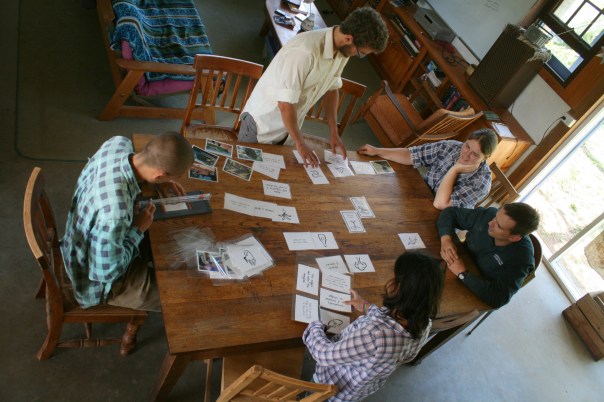
Helpers Jeremy, Francesco, Beck, Gav and Pooja laminating the teaching cards, and figuring out which ones go together.
Checking out the bees
Its been a difficult summer for the bees here at Violet Town this year, and for a lot of inland Victoria. There has not been much nectar flow available for the bees to make honey with. The Murrnong bees have remained healthy, with plenty of pollen, and plenty of brood. It is lucky that we left plenty of honey in the hives, because the girls have kept consuming their stored honey even through summer, when we usually hope to see them bringing in fresh honey. 2015 saw only 280mm of rain here, way down from the 625mm yearly average, so it has been tough for the plants, and one plant survival strategy is not to flower in dry conditions.

Mary from the February Backyard Bees course is holding up a frame of healthy brood.
Some bee keepers have been moving their hives for better forage elsewhere, and some have been feeding sugar syrup. We were just at the point of feeling we needed to move our hives, when Grey Box, E. microcarpa, started flowering. Fortunately, with 125mm of rain here between Christmas and end of January, there seems to have been enough moisture available for the Grey Box to put nectar in their flowers. So.. phew, when we are around the hives, we can again smell the sweet scent of nectar and fresh honey.
The next Backyard Bees hands on workshop is on Sunday March 20th.
Produce no waste
The 2015 2016 Murrnong PDC is happening over seven weekends, one weekend a month, focusing on one of the 12 design principles each day.
Here we were looking at how the wood chip compost at Murrnong takes branches and prunings from forest and orchard, combined with goat bedding wastes and occasional other goodies, and lets the composty critters work on it for more than one year. This produces beautiful wood chip compost to go back to the food producing tree crops. No waste.


Getting Started or Getting Better with Honey Bees
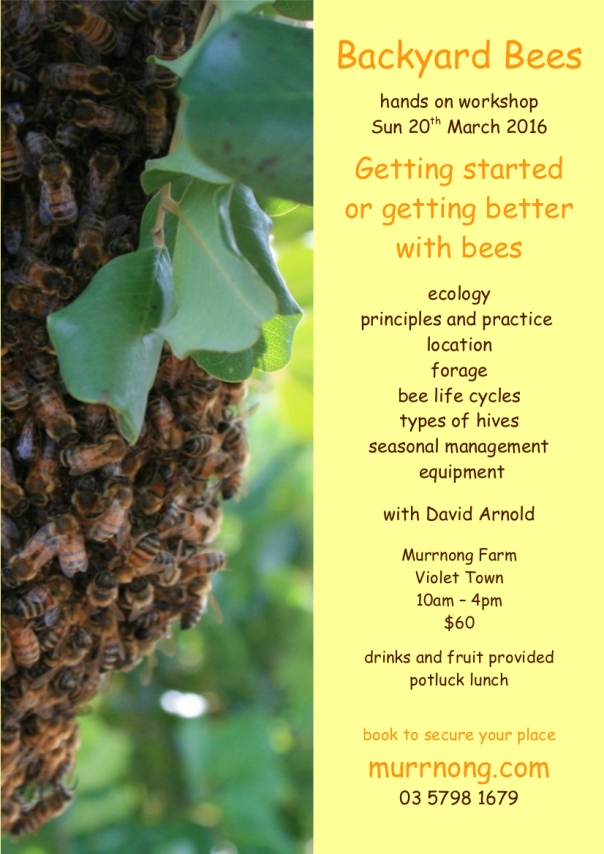
Keeping even just one hive of bees in your backyard can give a big surplus of honey, do wonderful things for the pollination and productivity of your garden, and can also help to make sure we have plenty of healthy bees for the future. A well placed and well managed bee hive, with the flight path out of people’s way, can be nothing but a positive. The first your neighbors might know about the hive you have had for the last six months could be when you give them a jar of honey. 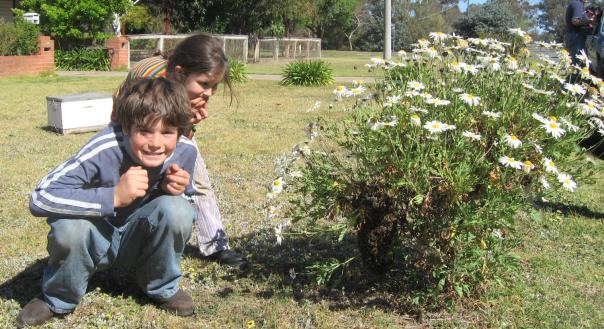
Felix and Grace Arnold excited and a little nervous about this bee swarm that their Dad was about to collect from a little bush in Violet Town in 2006
Bees are under stress around the world, bee numbers are down, the Varroa mite will probably get to Australia one day, and the neonicotinoid pesticides, so toxic to bees, continue to be used. Species diversity in large scale agricultural regions is now too low to feed bees through the year. In the apple and pear orchards of south west China, bees have been eradicated by pesticide use and habitat loss, and people have to do pollination (the free work of bees) by hand, with a feather and little bags of pollen. In Australia, beekeepers are paid to truck their bees in to pollinate horticultural crops.
There is species diversity in towns and home gardens, though. These are now an important bee forage resource. Backyard bees mostly feed from a different forage resource to commercially kept bees. The garden plants benefit, and we get the honey. Towns can provide a surplus of bees to support the surrounding agriculture or horticulture.
Backyard bee keepers often collect ‘wild’ bee swarms, and so are potentially working with a broader range of genetics in bees than is possible when all the bee queens are commercially bred. This is important to allow for continual evolution and adaptation among bees.
In Australia bees kept in backyards, or on rooftops in the city, generally have less exposure to insecticides than when bees are used for pollination in agriculture.
With their smaller scale, less commercial pressure, and hives kept mostly in one place, backyard bee keepers have opportunities to experiment and innovate with their bee keeping practices. All of this can contribute to a bee keeping culture of continuous improvement, and a healthy increase in bee numbers.
Getting Started or Getting Better with Bees with David Arnold, Sun 20th March 2016, Violet Town, $60 murrnong.com
murrnong@gmail.com, ph. 5798 1679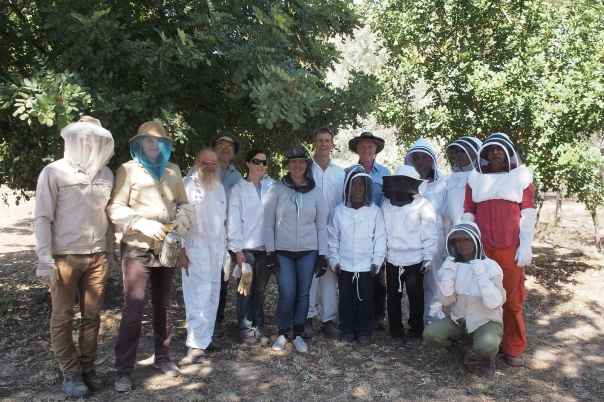
Ready for hive inspections at the Murrnong March 2015 Backyard Bees workshop.
Eldorado open consultation
Kate Marsh and Ralph Nottingham of Creative Collectives are putting on an open consultation at their property near Eldorado, Sun Nov 29 2015.
David Arnold will lead the workshop through the process of reading the landscape, figuring out how that land works, sift through their wish list to plan for functional connections, consider house site options, and develop a concept plan.
And… what can they do about water?
Kate says “Take the next step in learning about Permaculture. Come along and contribute to the planning of Hidden Valley Permaculture farm, Eldorado VIC.
Our Permaculture Transformation is about to begin.
20 acres, North-East Victoria, surrounded by national park, relatively clear site, sandy granitic soils, lots of wild life, mixed pasture, some infrastructure…..“

The Art of Free Travel book talk and forage walk

The Artist as Family (Zero, Meg, Patrick, Woody and Zephyr) came through Violet Town in 2013 on their family cycle tour from Daylesford to Cape York, and back. They ‘stealth’ camped by the creek, and had a good time here. They rested, met some people, foraged for some food, found a power outlet in the park to recharge their bikes, and in return for the 20c worth of power they used (0.6kWhr) they picked up some rubbish from around the park.
Now they are coming back, again on their bikes, to talk about their book of that journey, The Art of Free Travel.
Wednesday Nov 4th, here at Murrnong. 4pm to 8pm
At 4pm, Patrick will lead a forage walk to find some of the wild foods (some of them weeds) that sustained them on their journey. This part costs $10, if you can make it here at that time, for Murrnong.
At 6pm Patrick and Meg will give a book talk about their journey, the book, how they did it, why they did it, and are they complete nutters? This is free.
Bring a plate to share if you would like to stay for a meal together afterwards.
It helps us if you register here
The acorns are dropping, it’s time to pick them up
If there is a well established oak tree somewhere near you that you have admired, (and you live in the southern hemisphere) about now could be the time to collect some acorns and plant them. Don’t be put off by the moderate growth rate, the quality of the result in the longer term is well worth it, and you don’t have to hold your breath while they grow.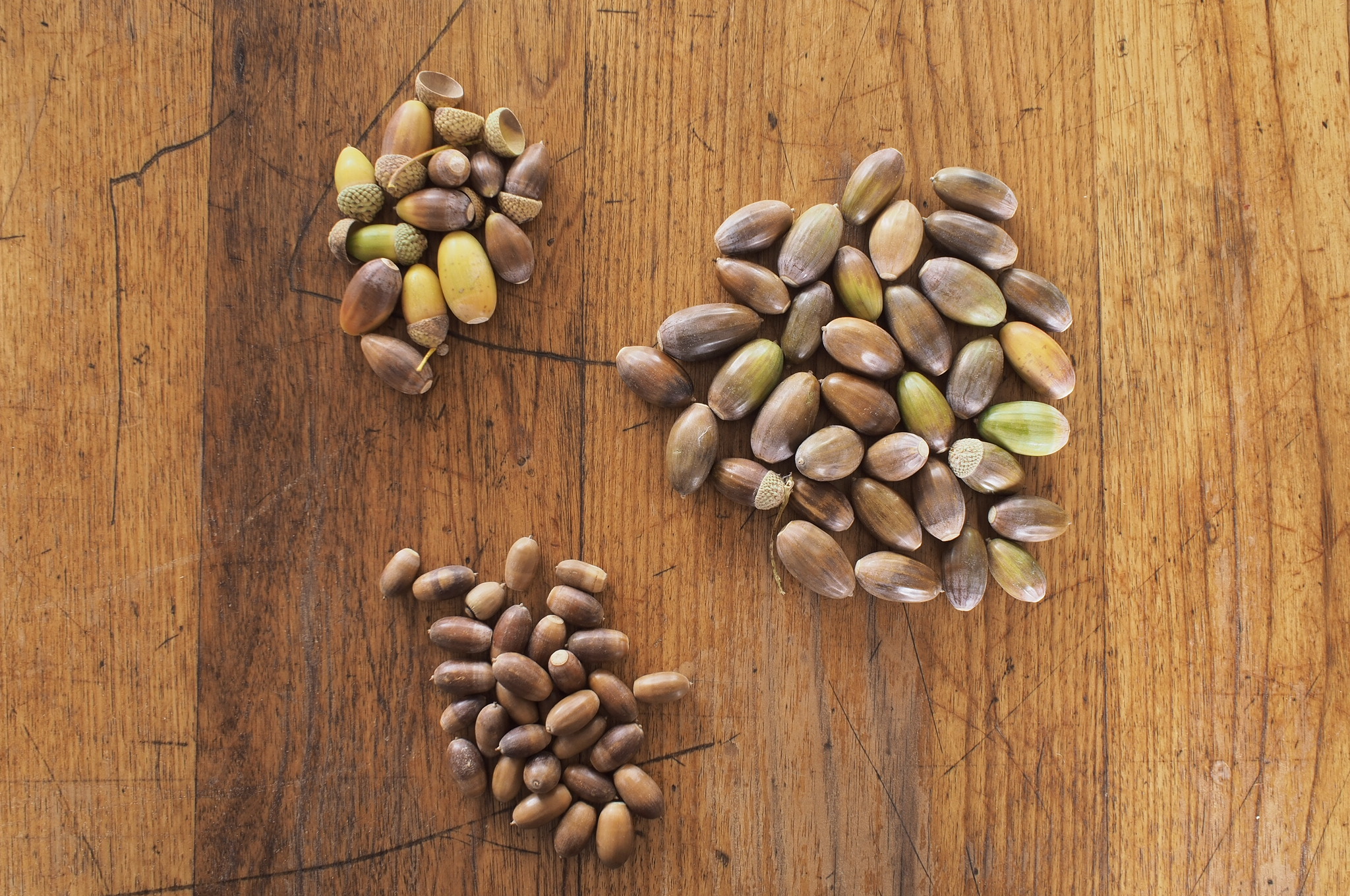
We collected these acorns yesterday from magnificent old street trees in Violet Town. I propagate from old trees well proven in this climate and landscape. Our seedlings from these trees are just this year bearing their first acorns, in fact some of those are the lighter acorns in the top picture. These particular acorns have been carefully selected for their freshness and firmness, for planting. Mostly we just rake the acorns up, remove most of the dirt and leaves in a big sieve, and store for goat feed over the next few months. The goats make their own firm decisions about which ones they will eat. The goats’ milk becomes more mellow, richer and creamier 24hrs after their first feed of acorns in the autumn.

March 2015 Dappled light coming through the heavy shade of oaks planted here in 2006. The canopies are still small, but growing well. Heavy shade, soil improving qualities, fire retardant, beauty, and acorns for concentrated autumn fodder are why we planted these. These are possibly Algerian oaks. These trees are only semi-deciduous, staying green until the end of July, going brown in Autumn, then dropping their old leaves just as the new growth comes. This makes them well adapted to this relatively hot and dry climate, as they are able to make use of the usually more moist conditions in winter.
We have been planting oaks here since 1996. We were collecting acorns for autumn goat feed supplement anyway, so it was a no-brainer to try planting them. This is the oak establishment method that has worked best here, on this farm in this climate.
- Autumn, approx March yr1. Collect or source acorns, keep in a damp cool place [eg in veg garden soil] or in a plastic bag in the fridge over the first winter.
- Late Winter, August yr1 Plant in veg garden if you haven’t already done so
- Summer, yr1 Grow in veg garden over the first summer. A couple of times over summer drive a spade about 30cm under the tree seedlings, to cut the tap root and encourage more shallow root development.
- Late Winter, August yr2 dig up from veg garden, prune excessively long roots, and plant out into spots or rip lines cleared of grass, with whatever compost you can spare.
- Spring yr2 Keep about a 1m radius around the tree clear of strong competitive grass for the first summer in the field
- Spring yr3 Clear strong grass away from young trees again to give them a chance to grow with the Spring moisture and warmth.

Nov 2006. The first year of planting, David follow up watering in acorns seeded direct into rip lines, in a drought year…….. I must have been keen! That area looks a lot nicer now. The previous photo, of the foliage, was taken about 6m to the right from here.
We have not tried leaching the tannins from acorns so we can eat them ourselves, but some friends do, and there is lots of information available about this, for example here.
Calm autumn weather perfect for opening up hives
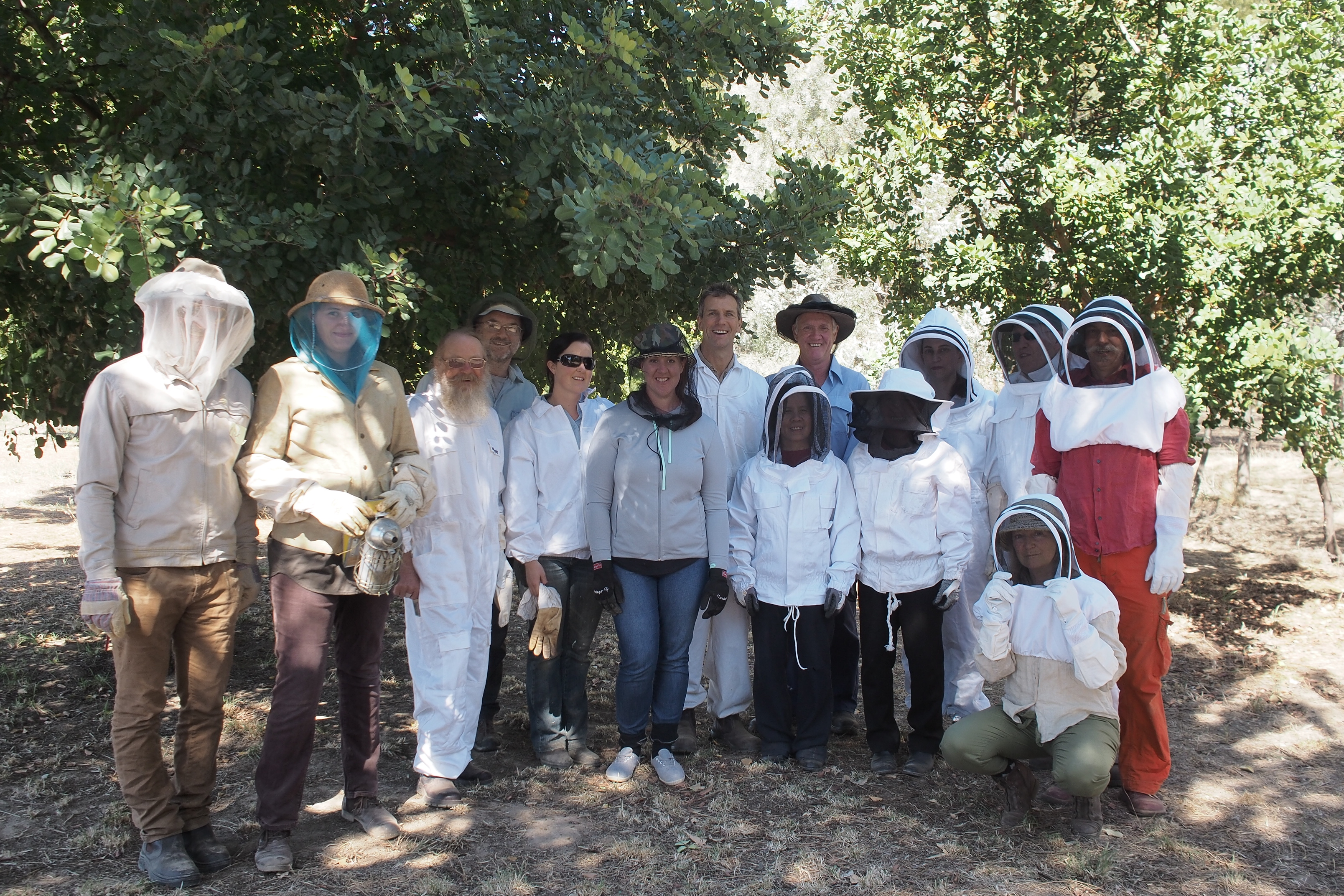
March 22nd 2015 Backyard Bees workshop
With two consecutive Sundays of perfect warm, calm conditions, bees preoccupied with good nearby forage on our Spotted Gums in full flower, and a range of improvised and purpose made protective clothing, we had two terrific Backyard Bees workshops this autumn. Everyone handled and closely inspected frames covered in bees, and only one thinly gloved hand felt a bite. Nga was fine.
Suzie said “I really enjoyed the bee keeping workshop on Sunday. We came away very inspired and will definitely be getting bees.”
Steve said “Thank you for the day it was fantastic. I just needed exactly what you provided to round off and understand what I have been doing. I was particularly taken by the time that you had the hive open. I tend to be a little freaked about leaving the hive open, but not anymore as the bees were quite happy with what you/we were doing.”
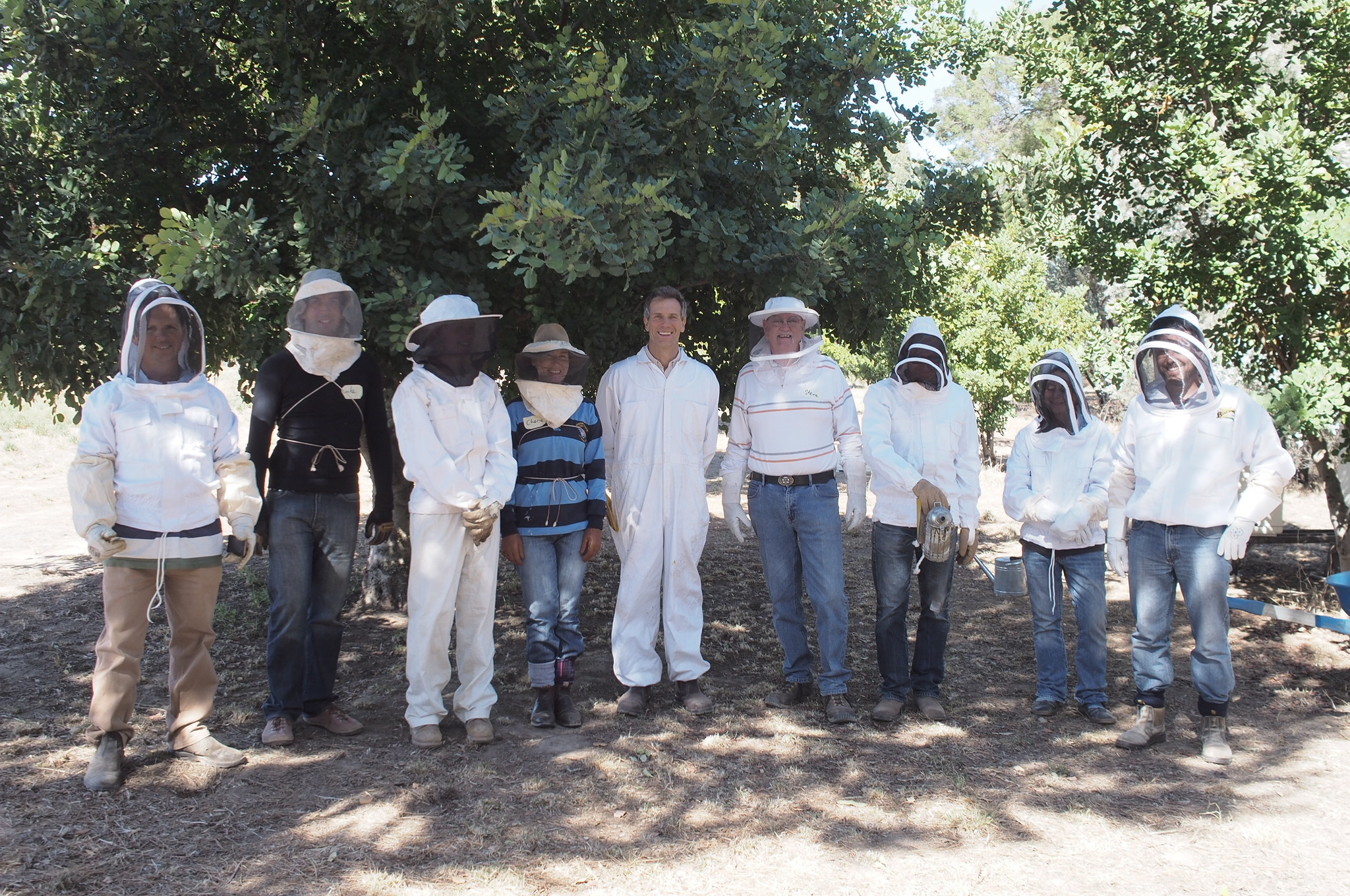
March 29 2015 Backyard Bees workshop
 Murrnong